

Best overall for an identified vitamin E gap: a clearly labelled single-ingredient supplement. Best for broader dietary gaps: a multivitamin containing vitamin E. Best for swallowing difficulties: a measured liquid. This 2026 guide ranks supplement types by purpose, rather than treating the strongest capsule as the best choice.
- The best vitamin E supplement UK choice depends on dietary need, dose and medicines—not capsule strength.
- Single-ingredient vitamin E suits a specific gap; a multivitamin suits broader nutritional needs.
- The SRX Formula suits adults seeking a structured wellness routine, rather than vitamin E alone.
- Vitamin E supports normal cell protection; that does not establish wrinkle reduction or treatment for dry skin.
Why this matters
Vitamin E contributes to the protection of cells from oxidative stress. That established nutritional function is not the same as evidence that taking extra vitamin E reverses skin ageing.
If you are searching because your skin looks drier or more tired, start with the problem—not the bottle. Hormonal changes, skincare irritation and other health factors deserve attention; appearance alone does not diagnose a nutrient deficiency. The guide to vitamin E supplements for skin health in women explores that distinction.
The best supplement corrects a relevant nutritional gap without creating an unnecessary extra dose. For most healthy adults eating a varied diet, a dedicated vitamin E supplement is not automatically necessary.
What makes the best vitamin E supplement?
Use these criteria when comparing UK labels in 2026:
- Relevant purpose: A specific vitamin E need, broader dietary support and a daily wellness routine are different buying decisions.
- Clear daily dose: Look for the amount per recommended daily serving, not just per capsule or bottle.
- Identifiable form: The label should name the vitamin E ingredient and make its units understandable.
- Suitable formulation: Check capsule materials, allergens and the complete ingredients list against your requirements.
- Manageable overlap: Count vitamin E across multivitamins, beauty blends and standalone products before adding another.
- Medicine compatibility: Ask a pharmacist about interactions, especially with anticoagulants or antiplatelet medicines.
A long ingredient list is not evidence of effectiveness. Neither is a high percentage of the nutrient reference value.
Vitamin E options at a glance
The ranking below is a decision tree. Each option serves a different purpose, and the final option addresses a broader routine rather than acting as a like-for-like vitamin E replacement.
| Option | Best for | Standout feature | Key limitation |
|---|---|---|---|
| Single-ingredient vitamin E | A specific nutritional gap | Keeps the vitamin E dose separate | Unnecessary when intake is already adequate |
| Multivitamin containing vitamin E | Broader dietary gaps | Combines several nutrients in one serving | Adds nutrients you do not necessarily need |
| Liquid vitamin E | Difficulty swallowing capsules | Avoids a capsule format | Requires careful measurement |
| Mixed-tocopherol formula | An informed preference for multiple forms | Includes more than one tocopherol | More forms do not establish better skin outcomes |
| The SRX Formula All-in-One Formula Box | A structured daily wellness routine | Three blends targeting energy, hydration, sleep and skin support | Not a like-for-like standalone vitamin E choice |
1. Single-ingredient vitamin E: best for a specific gap
A single-ingredient supplement supplies vitamin E without adding a broad range of other active nutrients. It is the clearest format when a healthcare professional identifies a reason to supplement vitamin E specifically.
Keep the goal narrow. A separate capsule makes the dose easier to track, but it does not establish that your skin needs it or that more produces better results.
Single-ingredient vitamin E pros:
- Keeps vitamin E separate from other nutrient doses.
- Makes overlap with existing supplements easier to identify.
- Lets you assess one active nutrient against one defined need.
Single-ingredient vitamin E cons:
- Adds little value when dietary intake is already adequate.
- Does not address unrelated causes of tired-looking or dry skin.
- High-dose products need particular care around medicines and bleeding risk.
Best for: Adults with a specific, professionally assessed reason to increase vitamin E intake.
Read the serving instructions carefully. Two products with similar-looking names can supply different daily amounts, and the amount per capsule is not always the amount per recommended serving.
Verdict: Buy only when the need and daily dose are clear.
2. Multivitamin containing vitamin E: best for broader dietary gaps
A multivitamin combines vitamin E with other vitamins and sometimes minerals. This format fits a broader nutritional question better than several separate bottles, provided the formulation matches your needs.
Choose by the complete label. The presence of vitamin E does not make every other ingredient appropriate, and a multivitamin does not replace a varied diet.
Multivitamin containing vitamin E pros:
- Combines several nutrients in one daily serving.
- Reduces the need to manage separate nutrient products.
- Provides a practical format for reviewing broader dietary gaps.
Multivitamin containing vitamin E cons:
- Includes ingredients you do not necessarily need.
- Makes changing vitamin E alone difficult.
- Creates overlap if you also take beauty or wellness blends.
Best for: Adults whose dietary review identifies several nutritional gaps rather than vitamin E alone.
For a 2026 supplement review, put every label side by side before choosing a multivitamin. Include powders and drinks: a nutrient still counts towards your intake when it is not delivered in a capsule.
Verdict: Buy for relevant broader support; skip an extra vitamin E capsule unless advised.
3. Liquid vitamin E: best for swallowing difficulties
Liquid vitamin E delivers the nutrient without a capsule. It is a format choice, not proof of better absorption or stronger skin benefits.
Choose a product with explicit oral-use instructions and a clearly stated serving. Cosmetic vitamin E oils are not substitutes for an oral supplement.
Liquid vitamin E pros:
- Avoids swallowing a capsule.
- Provides an alternative oral format.
- Allows the stated serving to be measured with the supplied device.
Liquid vitamin E cons:
- Requires more care with measurement than a fixed-dose capsule.
- Needs storage and handling according to its instructions.
- Is unsuitable if the product is intended only for external use.
Best for: Adults who have a reason to supplement vitamin E but struggle with capsules.
Do not estimate a serving from an ordinary kitchen spoon or assume all droppers deliver the same amount. Follow that product's instructions and ask a pharmacist if the directions are unclear.
Verdict: Buy for accessibility, not because liquid automatically means better.
4. Mixed-tocopherol formula: best for an informed form preference
Vitamin E is a family of compounds that includes tocopherols and tocotrienols. A mixed-tocopherol formula includes multiple tocopherols; the exact mixture depends on its ingredient list.
Alpha-tocopherol is the form recognised as meeting human vitamin E requirements. A broader mixture does not, by itself, establish better outcomes for wrinkles, dryness or healthy ageing.
Mixed-tocopherol formula pros:
- Offers multiple tocopherol forms within one formulation.
- Lets an informed buyer choose a particular ingredient profile.
- Supports ingredient-level comparison when the composition is disclosed.
Mixed-tocopherol formula cons:
- The total blend amount does not necessarily explain each component.
- Added forms do not establish a clinical advantage for your goal.
- The same dose and medicine checks still apply.
Best for: Adults choosing a particular tocopherol profile for a clear reason, ideally with professional advice.
Avoid treating terms such as mixed, full-spectrum or natural as a verdict. Check what the product contains and whether that information answers your actual nutritional question.
Verdict: Hold unless the form preference has a clear purpose.
5. The SRX Formula: best for a structured wellness routine
The SRX Formula is best suited to adults seeking a structured daily wellness routine rather than vitamin E alone. Its all-in-one supplement box comprises three precision blends targeting energy, hydration, sleep and skin support.
This is a different decision from buying a dedicated vitamin E capsule. Review the current ingredients and serving instructions before treating any all-in-one box as a source of a particular nutrient or combining it with separate supplements.
The SRX Formula pros:
- Organises supplementation around a daily routine.
- Brings several wellness priorities into one system.
- Offers an alternative to managing unrelated individual products.
The SRX Formula cons:
- Has a broader scope than a single-nutrient requirement.
- Requires a full-label review before combining it with other supplements.
- Is not a treatment for nutrient deficiency or unexplained symptoms.
Best for: Adults prioritising a coordinated energy, hydration, sleep and skin-support routine.
Verdict: Hold until the full formulation fits your needs; skip as a standalone vitamin E substitute.
How much vitamin E do you actually need?
NHS guidance states that adult women need 3 mg a day and adult men need 4 mg a day. It also states that you should be able to obtain the vitamin E you need from your diet.
The 12 mg nutrient reference value used on UK supplement labels serves a different purpose: standardised labelling. It is not an instruction that every woman must take that amount as a supplement.
Source context for this 2026 guide: NHS vitamin E guidance covers adult dietary needs; UK nutrition-labelling reference values explain label percentages. These figures answer different questions and should not be used interchangeably.
Vitamin E occurs in foods including nuts, seeds and vegetable oils. Assess your usual diet before deciding that an isolated capsule is necessary.
What about mg and IU?
Some labels use international units, or IU. Conversion depends on the form: 1 IU of natural vitamin E equals 0.67 mg of alpha-tocopherol, while 1 IU of synthetic vitamin E equals 0.45 mg.
Source: US National Institutes of Health Office of Dietary Supplements, Vitamin E Fact Sheet for Health Professionals, covering supplement forms and unit conversion. Use the ingredient name as well as the figure when comparing labels; identical IU values do not always mean identical milligram amounts.
Natural or synthetic: which should you choose?
Natural-source vitamin E commonly appears as d-alpha-tocopherol or RRR-alpha-tocopherol. Synthetic vitamin E commonly appears as dl-alpha-tocopherol or all-rac-alpha-tocopherol; labels also use related ester names such as acetate.
Compare the stated vitamin E amount, not the word natural alone. Origin does not establish that a product treats skin ageing, and capsule materials still need a separate check if you avoid animal-derived ingredients.
For a 2026 purchase, reject comparisons that ignore units or serving size. Compare the daily serving, the named form and the rest of the formulation together.
Check your routine before adding vitamin E
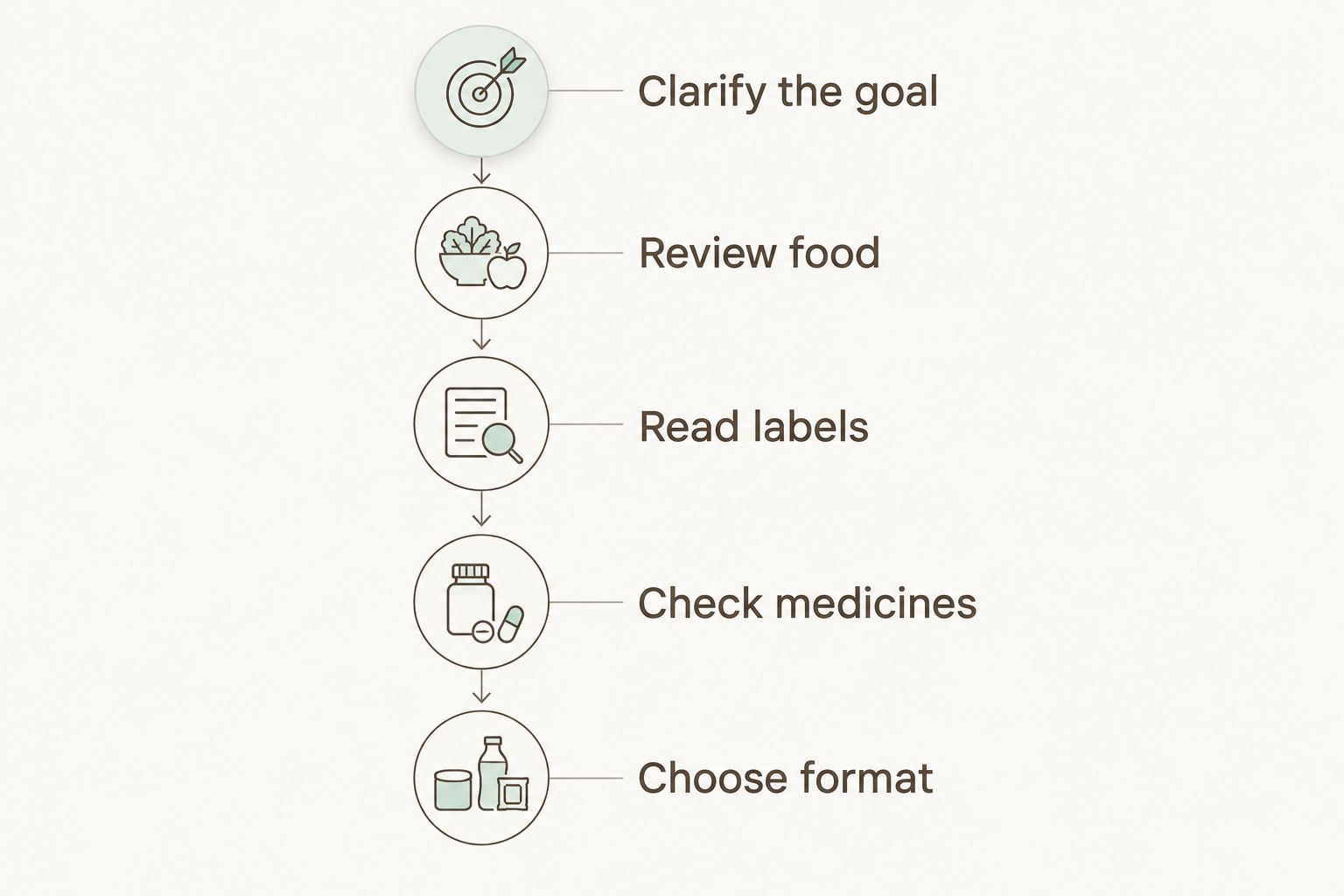
Use this sequence before introducing another supplement:
- Clarify the goal: Separate a dietary concern from a symptom such as persistent dry skin.
- Review food: Consider vitamin E sources in your usual meals.
- Read labels: Identify vitamin E across everything you already take.
- Check medicines: Ask a pharmacist to review relevant interactions.
- Choose format: Select the simplest suitable option once the need is established.
High supplemental vitamin E intake can increase bleeding risk, particularly alongside anticoagulant or antiplatelet medicines. Tell your surgical team about supplements before a procedure, and seek individual advice during pregnancy or breastfeeding.
How the options are ranked
The ranking prioritises a relevant purpose, dose transparency, formulation suitability and manageable overlap. It ranks buying approaches—not laboratory-tested brands or demonstrated skin results.
Single-ingredient vitamin E leads for a specific gap because its purpose is narrow. Multivitamins address broader needs, liquids address swallowing difficulties, and mixed tocopherols address form preference. An all-in-one routine belongs in a separate category.
Which vitamin E option should you choose?
For an undecided reader in 2026, the default is a dietary and label review—not a high-strength capsule. Choose standalone vitamin E only when you have a clear reason; choose a multivitamin when several relevant gaps need attention.
If sleep, energy and skin concerns occur together, assess the wider pattern rather than assuming one missing vitamin explains everything. Persistent or unexplained changes deserve a clinical assessment before another supplement.
FAQ
What's the best vitamin E supplement in the UK?
The best choice for a specific nutritional gap is a clearly labelled single-ingredient product with an appropriate daily dose. If your intake is adequate, a dedicated vitamin E supplement is not automatically necessary.
How much vitamin E do women need each day?
NHS guidance states that adult women need 3 mg of vitamin E a day. The 12 mg nutrient reference value on supplement labels is a standardised labelling figure, not a personal supplement prescription.
Is natural vitamin E better than synthetic vitamin E?
Natural and synthetic vitamin E differ in biological activity and IU conversion. Compare the named form and milligram amount; natural origin alone does not establish better skin outcomes.
Will vitamin E supplements improve dry skin or wrinkles?
Vitamin E's established nutritional role does not prove that extra supplements improve dry skin or wrinkles. Persistent dryness needs assessment of skincare, hormonal and medical causes rather than an assumption of deficiency.
Can I take vitamin E with a multivitamin?
Check the combined vitamin E amount before adding a separate capsule to a multivitamin. Ask a pharmacist whether the extra dose has a purpose and fits your medicines.
Can I take vitamin E if I use blood-thinning medicine?
Get a pharmacist or prescriber review before starting supplemental vitamin E with blood-thinning medicine. High supplemental intake can increase bleeding risk, particularly with anticoagulants or antiplatelet medicines.
Is The SRX Formula a standalone vitamin E supplement?
The SRX Formula is an all-in-one wellness system targeting energy, hydration, sleep and skin support, rather than a dedicated vitamin E supplement. Review its current formulation before using it to meet a particular nutrient requirement.
One last thing
Vitamin E deficiency is rare in healthy people and is more closely associated with certain fat-absorption disorders or inherited conditions than with simply looking tired. A change in your face is not a vitamin E test.
Take your supplement labels—not just product names—to a pharmacist. The useful question is whether the combined routine fits your needs, not which bottle has the strongest claim.