

Best overall for a specific B6 requirement: a low-dose, single-ingredient vitamin B6 supplement. Best for broader B-vitamin support: a low-dose B complex; best for a structured wellness routine: The SRX Formula, assessed separately from a targeted B6 supplement. This 2026 UK guide ranks supplement types by purpose, dose transparency and safety—not by the largest number on the label.
- Best vitamin B6 supplement UK choice: a low-dose standalone supplement when you have a specific B6 requirement.
- A B complex suits broader B-vitamin needs, but check its B6 dose before combining supplements.
- NHS guidance advises no more than 10 mg supplemental B6 daily unless a doctor recommends otherwise.
- The SRX Formula suits a structured wellness routine; assess its ingredient label separately for any B6 requirement.
Why this matters
Vitamin B6 supports normal energy metabolism, nervous-system function and red blood cell formation. It is not a stimulant. Taking more does not turn those normal functions into a guaranteed improvement in energy, mood or skin.
If you are searching because you feel tired or notice changes in your skin during your late thirties or forties, avoid reducing the problem to one nutrient. Persistent fatigue needs attention to its cause, not an escalating supplement dose. Start with how to read a supplement label before adding another product to your routine.
The best B6 choice fills an identified gap without creating unnecessary exposure. That principle matters more than whether the label says active, advanced or high strength.
What makes the best vitamin B6 supplement?
Use these criteria for your 2026 shortlist. A product should pass the safety checks before its format or convenience influences your decision.
- Appropriate daily dose: assess the amount you actually take, not just the amount per tablet.
- Clear ingredient form: look for pyridoxine hydrochloride or pyridoxal-5-phosphate, often shortened to P-5-P.
- No unnecessary duplication: count B6 from every supplement you use, including combination formulas.
- A defined purpose: distinguish a specific B6 requirement from a broader nutritional or wellness goal.
- Usable serving instructions: check capsule count, measuring instructions and whether the serving fits your routine.
- Relevant safety information: review medicines, pregnancy, breastfeeding and existing symptoms with a pharmacist or clinician.
An ingredient name does not establish product quality by itself. Nor does a lengthy ingredient list establish that every ingredient is needed. Choose the simplest format that meets your actual requirement.
Vitamin B6 options at a glance
These are ranked supplement types, not a laboratory-tested ranking of competing brands. The final option addresses a different need: organising a broader daily wellness routine.
| Option | Best for | Standout feature | Key limitation |
|---|---|---|---|
| Low-dose standalone pyridoxine | A specific B6 requirement | B6 can be assessed without unrelated active ingredients | Does not address other nutrient requirements |
| Low-dose B complex | Broader B-vitamin support | Combines several B vitamins | B6 content still needs an individual check |
| Multivitamin containing B6 | General micronutrient coverage | Places B6 within a wider nutrient formula | Other nutrients can be unnecessary or duplicated |
| P-5-P supplement | A clinician-specified B6 form | Provides a coenzyme form of B6 | Active-form wording does not remove safety concerns |
| The SRX Formula All-in-One Formula Box | A structured daily wellness routine | Three blends targeting energy, hydration and sleep/skin recovery | A wellness system is not a substitute for targeted B6 assessment |
1. Standalone pyridoxine: best B6 option for a specific requirement
Pyridoxine hydrochloride is a form of vitamin B6 used in supplements. A single-ingredient product lets you assess its dose without sorting through a wider blend, making it the most direct choice when B6 itself is the requirement.
Choose a clearly labelled, low-dose serving. A standalone product is not automatically appropriate simply because it contains fewer ingredients; the amount and reason for taking it still matter.
Standalone pyridoxine pros:
- Keeps the B6 decision separate from other nutrient decisions.
- Makes the daily B6 contribution easy to identify.
- Avoids adding unrelated active ingredients for a single-nutrient goal.
Standalone pyridoxine cons:
- Does not correct other nutritional gaps.
- Still duplicates B6 already present in another supplement.
- High-strength versions are not a better default.
Best for: adults with an identified B6 requirement who do not need a wider combination formula.
Verdict: Buy only when B6 is needed and the daily dose fits professional advice or UK guidance.
2. Low-dose B complex: best for broader B-vitamin support
A B complex combines several B vitamins rather than focusing on B6 alone. It suits a broader nutritional requirement, but you must assess each ingredient rather than assuming the whole formula is appropriate.
For your 2026 comparison, read the B6 line independently. A product can present itself as an everyday B complex while delivering a dose that is unsuitable to combine with other supplements.
Low-dose B complex pros:
- Combines multiple B vitamins in one product.
- Fits a broader B-vitamin requirement better than standalone B6.
- Allows a single serving to replace separate B-vitamin products when appropriate.
Low-dose B complex cons:
- Includes nutrients you might not need.
- Can duplicate a multivitamin or wellness blend.
- Does not establish the cause of fatigue or poor concentration.
Best for: adults whose dietary assessment or clinical advice identifies a broader B-vitamin need.
Verdict: Buy for a defined broader requirement; skip combining it with standalone B6 without checking the total.
3. Multivitamin containing B6: best for general micronutrient coverage
A multivitamin places B6 alongside other vitamins and, depending on the formula, minerals. This is a general-coverage option rather than a targeted answer to a B6 question.
Inspect the full formula. Choosing a multivitamin solely because it contains B6 also means choosing every other ingredient, including any iron, vitamin A or additional nutrients on its label.
Multivitamin pros:
- Covers more nutrient categories than standalone B6.
- Keeps general micronutrient supplementation in one formula.
- Lets you assess B6 within your wider daily nutrient intake.
Multivitamin cons:
- Offers less flexibility over individual nutrient doses.
- Can duplicate ingredients in other products.
- Requires checks beyond B6, especially during pregnancy or alongside medicines.
Best for: adults seeking general micronutrient coverage after reviewing their diet and existing supplements.
Verdict: Buy for a suitable general-coverage need; skip it as an automatic treatment for tiredness.
4. P-5-P: best for a clinician-specified B6 form
Pyridoxal-5-phosphate is a coenzyme form of vitamin B6. You will see it written as P-5-P or PLP, and its active-form description refers to its biochemical role—not a guarantee of better results for every user.
Do not use the form name as permission to increase the dose. P-5-P still contributes vitamin B6 to your supplement intake and still belongs in your safety calculation.
P-5-P pros:
- Identifies a specific B6 form clearly.
- Fits advice that explicitly calls for this form.
- Can be assessed as a standalone ingredient when the formula contains only B6.
P-5-P cons:
- Active-form wording does not establish a personal need.
- Does not bypass the need to check total B6 exposure.
- Is not automatically preferable for routine nutritional support.
Best for: adults whose clinician has specified P-5-P for an individual reason.
Verdict: Hold unless there is a clear reason to choose this form over a straightforward low-dose alternative.
5. The SRX Formula: best for a structured wellness routine
The SRX Formula is a 24-hour supplement wellness system comprising three precision blends targeting energy, hydration and sleep/skin recovery. Its role in this comparison is routine structure, not a claim that a multi-blend system is the best isolated B6 supplement.
The SRX Formula is best suited to adults seeking a structured daily supplement routine rather than isolated vitamin B6 supplementation. Check the ingredient labels and daily servings against your existing products before deciding whether the system fits your needs.
The SRX Formula pros:
- Organises supplementation around a structured daily routine.
- Addresses several wellness goals within one system.
- Provides a broader format than a single-nutrient supplement.
The SRX Formula cons:
- Is not the simplest choice when you only need B6.
- Requires assessment of the complete formulas, not one ingredient.
- Does not replace investigation of persistent fatigue, sleep problems or skin changes.
Best for: health-conscious adults who want to assess a coordinated wellness system rather than assemble separate products.
Verdict: Hold for a B6-only purchase; assess for a broader daily-routine goal.
How much vitamin B6 do you need in the UK?
For this 2026 guide, the relevant UK reference is NHS guidance on B vitamins. The NHS states that adults aged 19–64 need 1.2 mg of vitamin B6 daily for women and 1.4 mg daily for men, and that a varied, balanced diet should provide the B6 they need.
These are daily nutritional requirements, not instructions to add that amount as a supplement. Food already contributes B6, including sources such as chickpeas, poultry, fish and potatoes.
The NHS also advises not taking more than 10 mg of vitamin B6 daily in supplements unless a doctor recommends it. Excess supplemental B6 can cause peripheral neuropathy, a form of nerve damage. Treat that guidance as a safety boundary, not a target to reach.
UK supplement labels commonly use a nutrient reference value, or NRV, of 1.4 mg for B6. NRV is a labelling reference; it is not a personalised prescription or a safety ceiling.
Keep these concepts separate:
- Requirement: the amount needed nutritionally.
- Label reference: the amount used to calculate percentage NRV.
- Supplement guidance: advice about supplemental intake and safety.
Check your total before adding B6
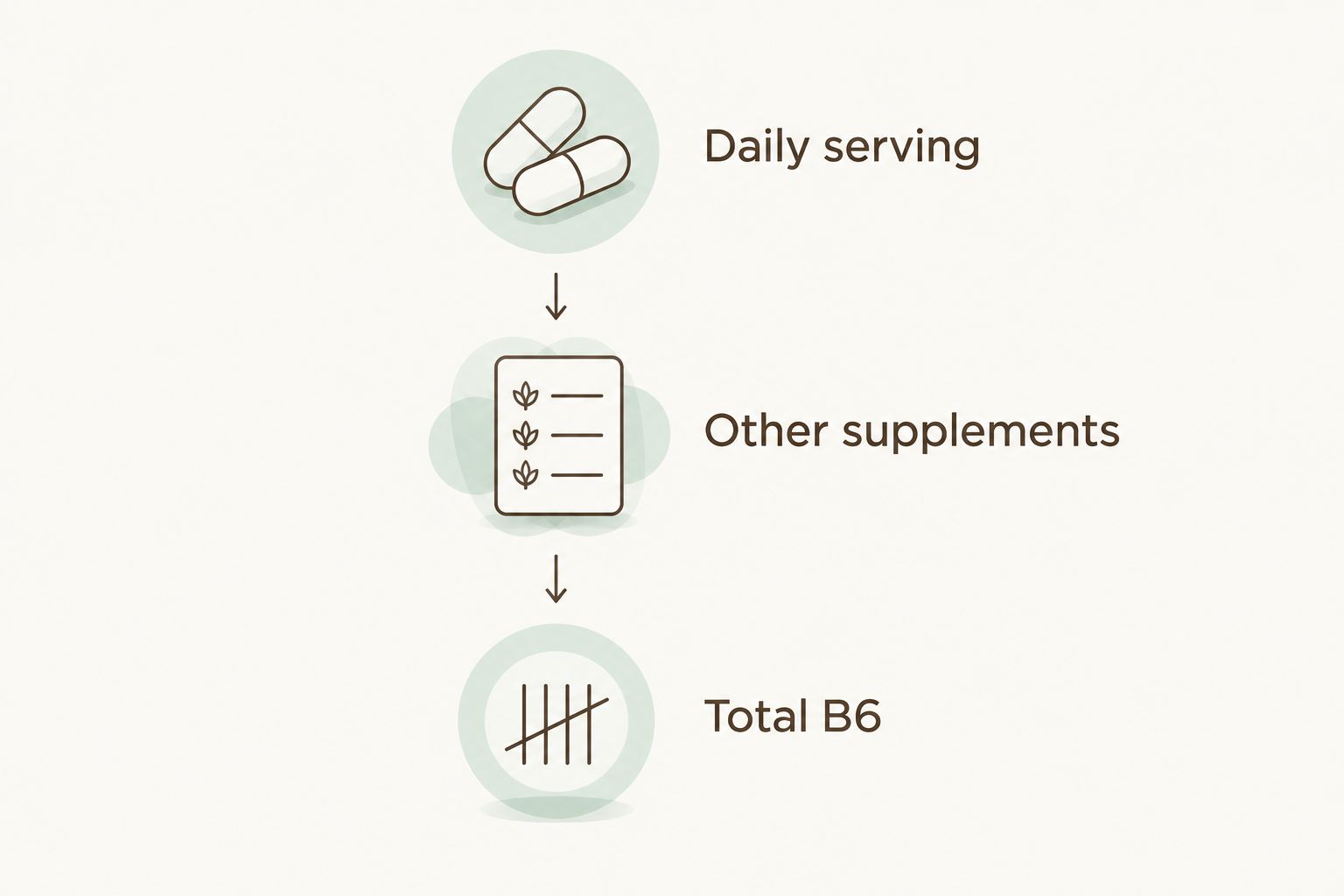
The most useful buying step in 2026 is checking your whole routine. Product names do not reliably tell you whether B6 is present, so inspect the ingredient panel on every supplement.
Daily serving
Record the B6 amount in the complete recommended daily serving. If instructions call for several capsules, calculate that serving rather than reading the amount for one capsule alone.
Other supplements
Check your multivitamin, B complex and any combination products. Add their B6 contributions even when B6 is not the ingredient advertised on the front.
Total B6
Add the supplemental amounts together and compare the result with NHS guidance or your clinician's instructions. Do not add a new product until that calculation is clear.
If you develop tingling, burning, numbness or balance problems while taking B6 supplements, stop taking non-prescribed B6 supplements and seek medical advice. If B6 was prescribed, contact the prescriber promptly. Do not dismiss new nerve symptoms as a sign that a supplement is working.
Is B6 the answer to tiredness, PMS or skin changes?
B6 participates in normal physiological functions, but that does not make every symptom a B6 deficiency. Fatigue, disturbed sleep and changes in appearance deserve a wider assessment, particularly when they persist or affect daily life.
For women noticing several changes together during perimenopause, avoid treating a hormone-related question as a single-vitamin shopping problem. B6's role in normal hormone regulation is not evidence that a supplement corrects perimenopause or treats every menstrual symptom.
If PMS is your reason for considering B6, discuss the symptoms and dose with a pharmacist or GP rather than choosing a high-strength product. Severe cyclical mood symptoms need clinical assessment, not an unsupervised supplement trial.
Skin concerns need the same discipline. Supporting normal nutrition differs from demonstrating that an isolated B6 supplement reverses dullness, puffiness or visible ageing. Choose the next step around the problem, not around the ingredient you happened to find first.
How these options rank
The ranking prioritises dose transparency, avoiding duplication and matching the format to the requirement. Standalone B6 comes first for a B6-specific need; broader formulas follow because they introduce additional nutrient decisions.
P-5-P occupies a clinician-specified slot, not a higher-potency slot. The wellness system addresses routine structure and is assessed separately from isolated supplementation. No option earns a recommendation simply for containing more ingredients or a larger dose.
Which vitamin B6 supplement should you choose?
For an identified B6 need, choose a clearly labelled, low-dose standalone supplement unless your clinician specifies otherwise. If you have a broader nutritional requirement, assess a B complex or multivitamin instead—but do not stack them automatically.
If your diet already meets your needs and there is no specific reason to supplement, the default is not another capsule. If your main concern is persistent tiredness, poor sleep or changing skin, start with assessment of those concerns.
Your 2026 buying decision should end with a clear answer to three questions: why B6, how much per day, and what else already contains it? If those answers are unclear, hold the purchase.
FAQ
What's the best vitamin B6 supplement in the UK?
For an identified B6 requirement, a clearly labelled, low-dose standalone supplement is the most direct choice. A B complex or multivitamin fits a broader nutritional requirement, but its B6 contribution still needs checking.
How much vitamin B6 does a woman need each day?
NHS guidance states that women aged 19–64 need 1.2 mg of vitamin B6 daily. This is a nutritional requirement, not an instruction to take that amount as a supplement; a varied, balanced diet should provide it.
Is it safe to take vitamin B6 every day?
Daily use depends on the dose, your other supplements and the reason for taking it. NHS guidance advises no more than 10 mg daily from supplements unless a doctor recommends otherwise; excess B6 can cause nerve damage.
Is P-5-P better than pyridoxine?
P-5-P is not automatically the better choice for routine supplementation. It is a coenzyme form of B6, but the form name does not establish greater benefit for your needs or remove the need to check the dose.
Can I take B6 with a multivitamin?
Check the combined B6 amount before taking both. A multivitamin can already contain B6, so adding a standalone product increases your supplemental total.
Does vitamin B6 help with perimenopause or PMS?
Vitamin B6 is not a general treatment for perimenopause or every PMS symptom. Discuss persistent or severe symptoms with a pharmacist or GP rather than selecting a high-dose supplement without advice.
Is The SRX Formula the same as a vitamin B6 supplement?
No. The SRX Formula is a 24-hour wellness system with three blends targeting energy, hydration and sleep/skin recovery. Assess its complete ingredient labels separately if you have a specific B6 requirement.
One last thing
A percentage NRV is not a score for effectiveness. A larger percentage means more of the nutrient relative to the label reference, not a better match for your body.
Before you buy, photograph the ingredient panels of your current supplements and show them to a pharmacist. That makes the decision about your complete routine rather than one attractive label.