

CoQ10 (coenzyme Q10) is one of the few supplements where the form and delivery method matter more than the brand on the label. Best overall for cellular energy support: high-strength ubiquinol CoQ10 (100-200mg daily). Best for people on statins: a low-dose ubiquinone CoQ10 taken after checking with a GP or pharmacist. Best budget option: standard ubiquinone softgels at the lower end of the 30-100mg range.
- Ubiquinol CoQ10 (100-200mg) is the best coq10 supplement uk shoppers over 40 should consider first for cellular energy.
- Standard ubiquinone CoQ10 (30-100mg) is the sensible budget starting point if you've never taken CoQ10 before.
- Anyone on statins should get pharmacist sign-off before adding CoQ10 - statins and CoQ10 use the same metabolic pathway.
- Oil-based softgels absorb better than dry powder capsules because CoQ10 is fat-soluble.
- Gummies and combination B-vitamin formulas suit different daily routines, not different biology.
Why this matters
CoQ10 sits inside the mitochondria, the part of your cells that produce roughly 95% of your body's usable energy. Levels fall with age, and by your 40s and 50s natural production is measurably lower than it was in your 20s.
Statins block the same liver pathway that makes cholesterol and CoQ10, which is why the two show up together so often in prescribing conversations. If you're on statins and researching CoQ10 for the first time, read how to choose supplements safely while taking statins before you buy anything.
The wider picture on cellular energy, not just the CoQ10 molecule, is covered in coenzyme Q10 for energy and cellular health, which is worth reading alongside this guide.
What makes the best CoQ10 supplement
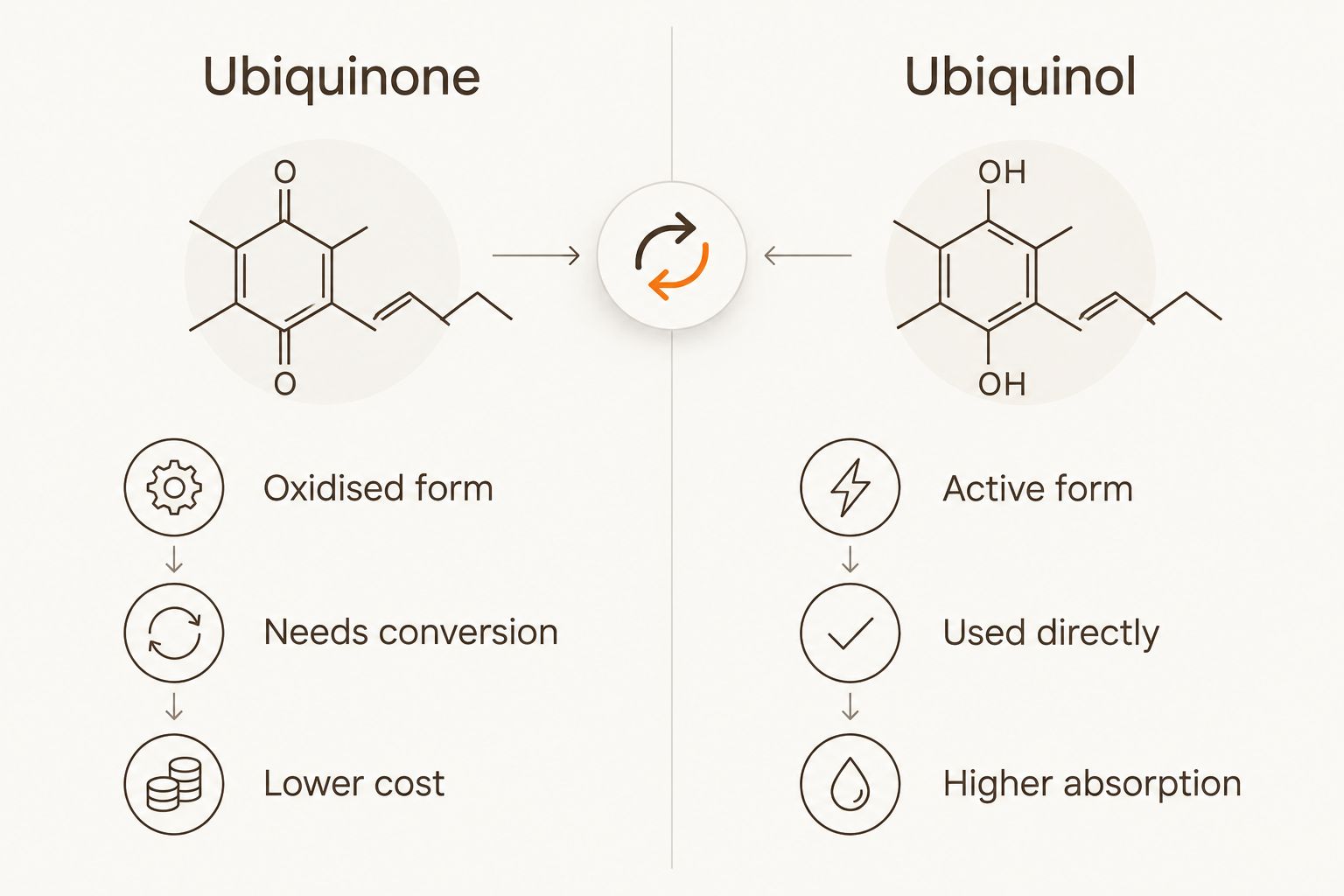
- Form - ubiquinol is the active, reduced form your body uses directly; ubiquinone needs converting first, which becomes less efficient with age.
- Dose - most CoQ10 supplements in the UK sit between 30mg and 200mg per day; higher doses are typically aimed at older adults or specific clinical contexts.
- Delivery - CoQ10 is fat-soluble, so oil-based softgels absorb more consistently than dry powder capsules or tablets.
- Statin compatibility - some formulations are marketed specifically for people on statin therapy; none of them replace a conversation with a GP or pharmacist.
- Purity and testing - third-party tested batches reduce the risk of contamination or mislabelled dosage, a known issue across the unregulated supplement market.
- Formulation partners - CoQ10 paired with vitamin E or black pepper extract is common because both are believed to support absorption of fat-soluble compounds.
CoQ10 supplement types at a glance
| Type | Best for | Standout feature | Key limitation |
|---|---|---|---|
| Ubiquinol CoQ10 (100-200mg) | Overall pick, adults 40+ | Active form, no conversion step needed | Fewer product options than standard ubiquinone |
| Standard ubiquinone CoQ10 (30-100mg) | First-time buyers on a budget | Widely available, well-studied form | Needs conversion, less efficient with age |
| Statin-safe low-dose CoQ10 | People on statin medication | Lower dose, positioned for medical contexts | Requires GP or pharmacist sign-off first |
| Oil-based softgel with vitamin E | Absorption-focused buyers | Fat-soluble delivery plus antioxidant partner | Softgels can be bulkier to swallow |
| CoQ10 gummies | People who dislike capsules | Easier daily habit to stick to | Usually lower mg per dose than softgels |
| CoQ10 + B-vitamin energy blends | All-day energy support | Broader nutrient coverage in one product | CoQ10 dose often diluted by other ingredients |
1. Ubiquinol CoQ10 (100-200mg): best overall for cellular energy support
Ubiquinol is the reduced, already-active form of CoQ10. Your body doesn't need to convert it before it can use it, which is the main reason it's positioned as the stronger option for anyone over 40.
Ubiquinol CoQ10 pros:
- Used directly by cells without a conversion step
- Suits adults whose natural CoQ10 production has already declined
- Available at higher doses (100-200mg) for more noticeable dietary support
Ubiquinol CoQ10 cons:
- Costs more per capsule than standard ubiquinone
- Fewer brands stock it compared with ubiquinone
- Overkill for younger adults with no specific energy concerns
Best for: adults 40+ looking for the most bioavailable CoQ10 form. Verdict: Buy.
2. Standard ubiquinone CoQ10 (30-100mg): best budget-friendly starting point
Ubiquinone is the oxidised form of CoQ10 and the one most UK high-street and pharmacy shelves stock as standard. It's the form most clinical CoQ10 research has historically used.
Ubiquinone CoQ10 pros:
- Widely available across UK pharmacies and health stores
- Backed by the largest body of CoQ10 research
- A sensible low-risk way to trial CoQ10 for the first time
Ubiquinone CoQ10 cons:
- Requires your body to convert it before use
- Conversion efficiency drops with age
- Lower doses may feel underwhelming if you're specifically chasing energy support
Best for: first-time buyers who want to test CoQ10 before committing to a stronger form. Verdict: Buy.
3. Statin-safe low-dose CoQ10: best for statin users
Statins and CoQ10 share a metabolic pathway in the liver. Anyone taking a statin considering CoQ10 should treat this as a medical question first, not a shopping question.
Statin-safe CoQ10 pros:
- Lower doses reduce the risk of interaction concerns
- Positioned clearly for the statin-user context, which simplifies label-reading
- Often paired with clearer dosing guidance on pack
Statin-safe CoQ10 cons:
- Still requires a GP or pharmacist conversation before starting
- Lower dose may do less for general energy support
- Not a substitute for medical advice on statin side effects
Best for: anyone currently on statin medication. Read the full breakdown in how to choose supplements safely while taking statins before buying. Verdict: Hold until you've checked with a pharmacist.
4. Oil-based softgel CoQ10 with vitamin E: best for absorption
CoQ10 is fat-soluble, meaning it absorbs better suspended in oil than as a dry powder in a hard capsule. Pairing it with vitamin E, itself fat-soluble, is a common formulation choice for this reason.
Oil-based softgel pros:
- Better absorption profile for a fat-soluble compound
- Vitamin E pairing adds antioxidant support
- Common format across established UK supplement brands
Oil-based softgel cons:
- Larger capsule size than some tablets
- Slightly more expensive to manufacture than dry-fill capsules
Best for: buyers who specifically want maximum absorption per milligram. Verdict: Buy.
5. CoQ10 gummies: best for people who dislike swallowing capsules
Gummies solve a compliance problem more than a biology problem. If you've stopped taking a supplement because you kept forgetting to swallow the capsule, this format fixes that.
CoQ10 gummy pros:
- Easier daily habit for people who dislike pills
- No water needed, useful for travel or desk-based routines
CoQ10 gummy cons:
- Usually lower mg per serving than softgels
- Often contains added sugar to make the format work
Best for: people whose main obstacle to consistency is the format, not the dose. Verdict: Buy if consistency is your real problem.
6. CoQ10 + B-vitamin energy blends: best for all-day energy support
Combination formulas bundle CoQ10 with B-vitamins aimed at broader energy metabolism rather than isolating one compound. This suits people building a daily routine around energy rather than chasing one ingredient.
Combination blend pros:
- Covers more of the energy-metabolism picture in one product
- Useful for people who don't want to manage multiple separate bottles
Combination blend cons:
- CoQ10 dose is often diluted relative to a standalone product
- Harder to isolate which ingredient is doing what
If you're weighing a single-ingredient approach against a structured daily system, The SRX Formula takes the second route: three separate blends across morning, afternoon and night rather than one combined pill, which some readers researching CoQ10 use as their next comparison point.
Best for: people who want energy nutrients bundled into a routine rather than tracked ingredient by ingredient. Verdict: Buy if you prefer routine over isolation.
Compare a full daily system
See how a structured morning-to-night routine differs from a single supplement.
“If a CoQ10 label doesn't say ubiquinone or ubiquinol, assume it's the cheaper ubiquinone form and price accordingly.”
How we ranked
Each type was assessed against the six criteria above: form, dose range, delivery method, statin compatibility, purity/testing, and formulation partners. No pricing data or brand-specific claims are used because retail prices and specific third-party product specs change too often to state reliably in 2026. Before buying any CoQ10 product, check current labelling directly against these criteria rather than against a fixed list of named brands. If you want a broader gut-check on supplement quality generally, how to spot low-quality supplements before you buy covers the label red flags worth checking.
Which CoQ10 supplement should you choose?
If you're over 40 and have no statin prescription, ubiquinol CoQ10 at 100-200mg is the default pick for 2026. If you're new to CoQ10 and want to test tolerance first, start with standard ubiquinone at a lower dose. If you're on a statin, stop before you buy anything and speak to a pharmacist first - that conversation matters more than any product choice on this list.
FAQ
What is the best CoQ10 supplement in the UK right now?
For most adults over 40, ubiquinol CoQ10 at 100-200mg daily is the strongest overall pick because it skips the conversion step ubiquinone needs. Budget buyers and first-time users are better starting with standard ubiquinone at a lower dose.
Is ubiquinol better than ubiquinone?
Ubiquinol is the active, already-usable form of CoQ10, while ubiquinone needs converting by the body first. Ubiquinol tends to suit older adults whose natural conversion has slowed, though ubiquinone remains the more researched and widely available option.
Can I take CoQ10 with statins?
Statins and CoQ10 share a liver pathway, so anyone on statin medication should check with a GP or pharmacist before adding CoQ10. Don't start a CoQ10 supplement alongside statins without that conversation.
How much CoQ10 should I take daily?
Most UK CoQ10 supplements sit between 30mg and 200mg per day. Lower doses suit first-time users, while higher doses are more common in ubiquinol products aimed at adults over 40.
Does CoQ10 help with tiredness or fatigue?
CoQ10 plays a role in mitochondrial energy production, where roughly 95% of the body's usable energy is generated. It's taken as part of a broader energy-support routine rather than as a standalone fatigue fix.
Are CoQ10 gummies as effective as capsules?
Gummies typically carry a lower CoQ10 dose per serving than softgels, so they suit people whose main barrier is remembering to take a capsule rather than dose maximisation. Softgels remain the stronger choice if absorption per milligram is the priority.
How long does CoQ10 take to work?
CoQ10 is taken as part of an ongoing daily routine rather than for a quick effect, and consistency over weeks matters more than any single dose. There's no fixed UK-published timeline that applies to every user.
Is CoQ10 safe to take every day in 2026?
CoQ10 is widely available as a daily supplement in the UK, but anyone on medication, particularly statins, should confirm safety with a pharmacist first. Pregnant or breastfeeding women should also check with a GP before starting.
One last thing
The detail most buyers skip is the label wording itself: if a CoQ10 product doesn't specify "ubiquinol" or "ubiquinone" anywhere on the front or back of pack, it's almost always the cheaper ubiquinone form sold at a premium price point. Checking that one word before you buy saves more money than comparing brand names.